


What Are Varicose Veins?
Common Symptoms of Varicose Veins
“Bulging veins are visible on my legs.”
“My legs swell easily, feel heavy, and get tired quickly.”
“I have calf cramps at night or in the early morning.”
If you experience these symptoms, you may have varicose veins.
Below, we explain varicose veins in detail, including symptoms, types, causes, diagnosis, and treatment options.

What Are Varicose Veins?
Varicose veins are a chronic venous disorder in which the superficial veins in the legs become enlarged, twisted, and bulging due to malfunctioning valves.
The veins in the legs are divided into two main systems:
・Deep veins large veins located deep within the leg muscles
・Superficial veins smaller veins located just beneath the skin
Varicose veins occur when the superficial veins fail to return blood effectively to the heart, leading to blood pooling and visible swelling.
Symptoms
The signs and severity of varicose veins vary from person to person.
In addition to visible, rope-like, or protruding veins, patients may experience:
・Swelling and tightness
・Heaviness, fatigue, and tired legs
・Warmth or flushing, or conversely, a sensation of coldness
・Nighttime or early-morning calf cramps
・Occasionally, numbness in the calves or feet

In more advanced cases, varicose veins may cause:
・Itching, dermatitis, or eczema
・Skin discoloration (hyperpigmentation)
・Hardening of the skin and subcutaneous fat
・Non-healing venous ulcers
Causes
Veins return blood to the heart. Because humans stand upright, blood in the legs must travel upward against gravity. To prevent backward flow, veins contain one-way valves.
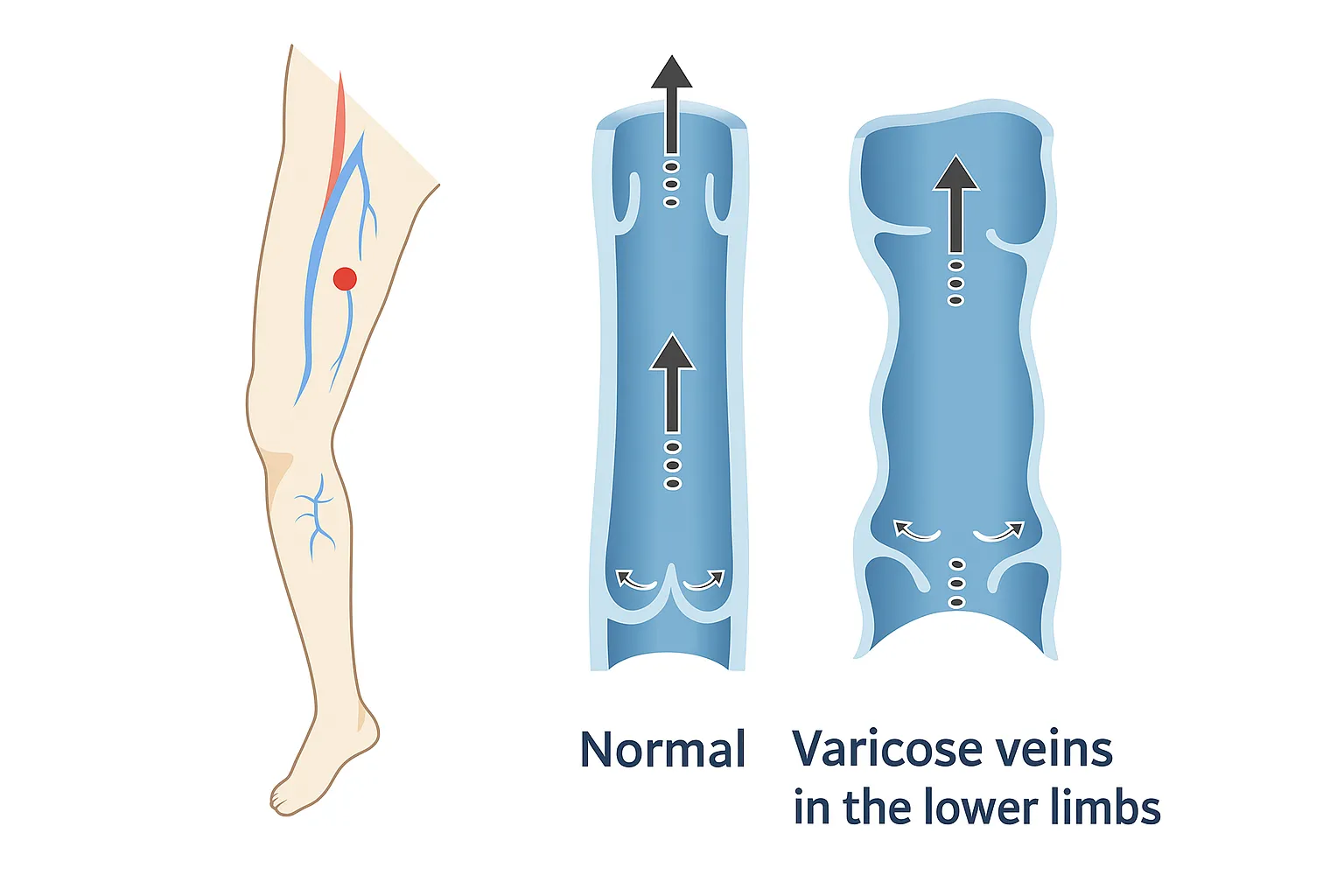
When these valves are damaged - for example due to pregnancy, childbirth, prolonged standing, obesity, or increased venous pressure - blood can flow backward (reflux), causing pooling and dilation of the vein.
Age-related decline in calf muscle pump function also contributes to the development of varicose veins.
Risk Factors
・Female sex - Women are about four times more likely than men to develop varicose veins. Pregnancy and childbirth are major risk factors.
・Older age - Aging weakens veins and valves; hormonal changes in women further increase risk.
・Family history - A genetic predisposition increases the likelihood of developing varicose veins.
・Prolonged standing or sitting - Common among teachers, nurses, hairdressers, chefs, flight attendants, and office workers.
・Obesity - Excess body weight increases venous pressure in the legs.
Types of Varicose Veins
There are four main types of varicose veins in the lower limbs.
We often explain them using the image of a tree: the main “trunk” represents the saphenous veins, the “branches” represent branch varicose veins, and the fine “twigs” represent reticular and spider veins.
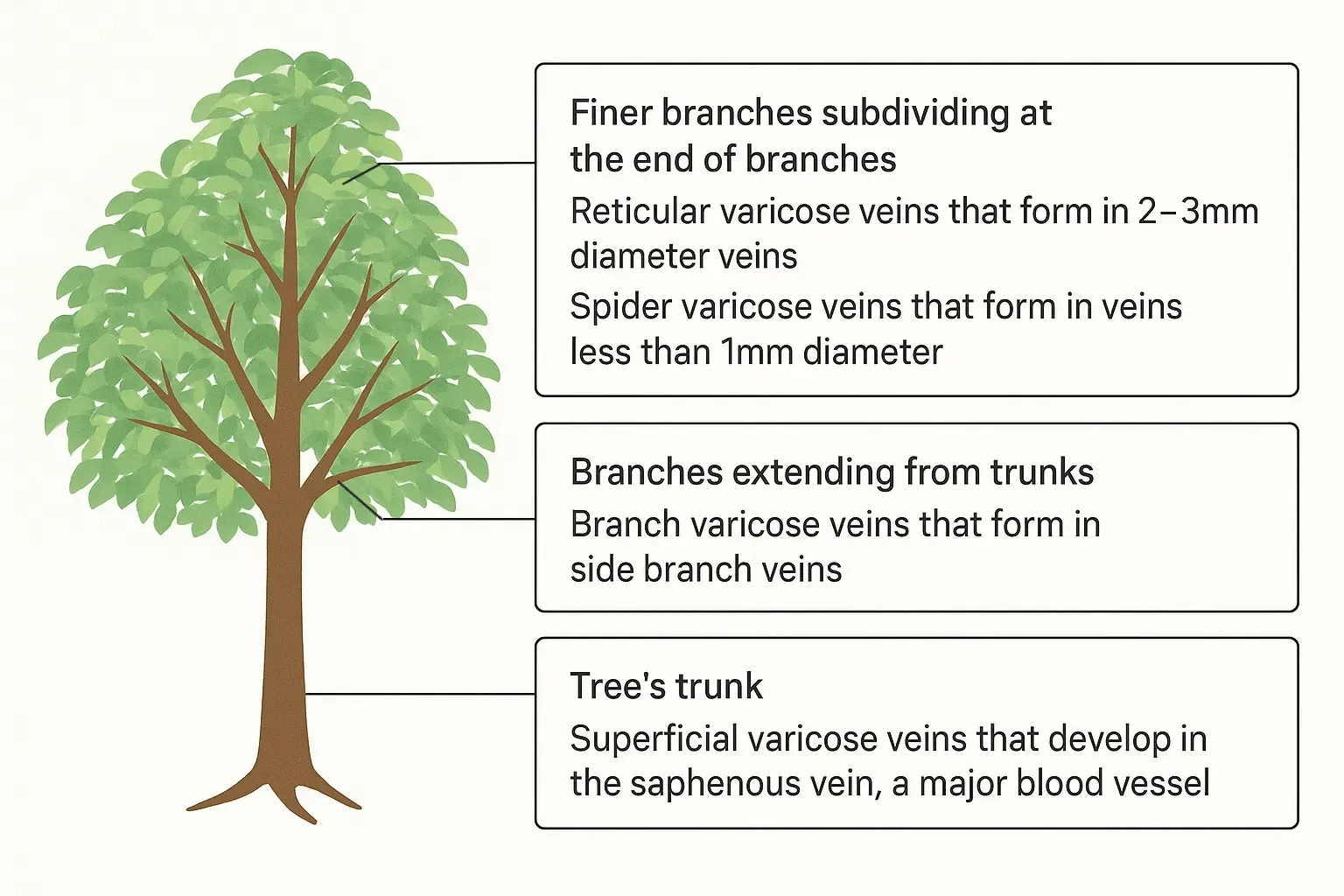
Saphenous Varicose Veins
Affecting the great or small saphenous vein; this is the most common type (about 70-80% of cases).
Appearance: Large, bulging veins visible along the thigh or calf.
【Recommended treatment options】

Branch Varicose Veins
Develop in smaller veins branching from the saphenous vein.
Appearance: Localized bulges, often on the calf, thigh, or the back of the thigh.
【Recommended treatment options】

Reticular Varicose Veins
Dilated subcutaneous veins, 1-2 mm in diameter, forming a net-like pattern.
Appearance: Blue or bluish-purple veins beneath the skin with minimal bulging.
【Recommended treatment options】
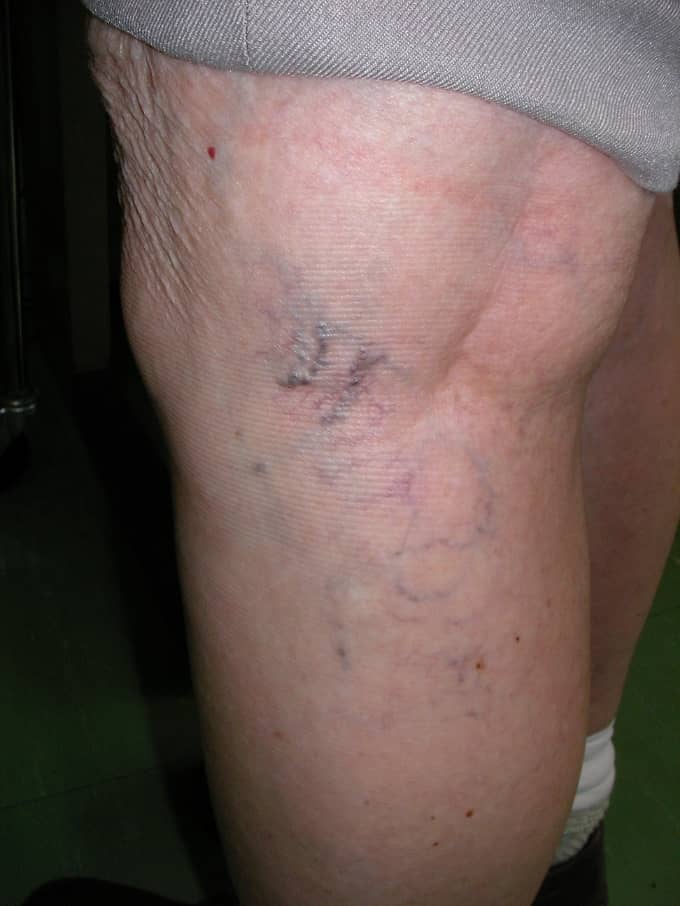
Spider Veins (Telangiectasia)
Very fine dermal veins (<1 mm) radiating in a spider-web pattern.
Appearance: Purple or blue lines on the skin surface without bulging.
【Recommended treatment options】

Why Early Evaluation Matters
These four patterns often coexist in the same leg, and the condition tends to progress gradually over time.
Varicose veins are not usually life-threatening, but if they are left untreated they can worsen and lead to eczema, skin darkening (hyperpigmentation), or even venous ulcers.
When these skin changes appear, it is as if your legs are “sending a warning signal” that the condition has reached its limit.
If you have symptoms or visible changes that concern you, it is important to consult a specialist before the condition worsens and to understand the current state of your leg veins.
Diagnosis of Varicose Veins
Diagnosis at our clinic begins with a comprehensive clinical examination, including:
・Medical interview (history taking) - Understanding your symptoms, duration, lifestyle, and medical history.
・Visual inspection - Checking for visible vein changes, swelling, or skin discoloration.
・Physical examination - Gently palpating affected areas to assess vein condition.

We then perform a Doppler ultrasound (“echo”) scan:
・Conducted while standing; takes about 10 minutes
・Painless and safe, with no radiation exposure
・Assesses the presence, location, and severity of varicose veins
・Detects blood clots and screens for deep vein thrombosis
Treatment Options at Our Clinic
At Tokyo Vein Clinic, all examinations, diagnoses, and treatments are performed by our Director and vascular surgeons affiliated with the University of Tokyo Vascular Surgery Group.
We provide all currently approved treatments for varicose veins in Japan, and these are covered by the Japanese National Health Insurance (except certain optional private treatments).

Endovenous Laser Ablation (EVLA)
A minimally invasive laser procedure that seals the diseased vein under local anesthesia.
Radiofrequency Ablation (RFA)
Uses radiofrequency energy to close the vein from the inside.
Endovenous cyanoacrylate closure (CAC), also known as “glue closure” therapy
A non-thermal endovenous treatment that closes the diseased vein using a medical adhesive (NBCA).
Sclerotherapy
Injection of a sclerosing agent, such as polidocanol, into the vein.
Phlebectomy (Micro-incision vein removal)
A traditional, well-established surgical technique mainly used for branch-type varicose veins under local anesthesia.
Laser Therapy for Very Small Spider Veins (Private/Self-Pay)
YAG laser therapy for extremely small veins that are unsuitable for sclerotherapy.
Stripping Surgery
Surgical removal of the saphenous vein with damaged valves.
TVC Method (Tokyo Vein Clinic Method)
A proprietary technique that combines EVLA or RFA of the main saphenous vein with additional targeted ablation of varicose branch veins.
Compression Therapy
Compression therapy is the fundamental supportive treatment for varicose veins, regardless of type.
It involves wearing medical-grade graduated compression stockings to improve venous return and alleviate swelling and heaviness in the legs.
Although compression therapy is not a cure, it can:
We also recommend compression stockings after these procedures to aid healing and help prevent recurrence of varicose veins.
Why Closing or Removing the Vein Is Safe
Whether a diseased vein is closed (as in endovenous laser ablation, radiofrequency ablation, or glue embolization) or removed (as in surgical stripping or varicectomy), these procedures do not harm overall circulation in the leg.
Around 90% of the blood flow in the legs travels through the deep veins, not the superficial veins treated for varicose vein disease.
When an abnormal superficial vein is closed or removed, blood flow is naturally redirected to healthy, functioning veins.
In many cases, the damaged vein actually impairs normal circulation because of faulty valves and venous reflux.
By eliminating this abnormal pathway - whether by sealing it or removing it - we can:
Next,
we will explain the treatment philosophyof Tokyo Vein Clinic.Treatment Philosophy
we will explain about Tokyo Vein Clinic.For First-Time Patients